By Ernest Mabry, Garage Door Guides Editor
Updated October 2026
Short answer
Garage door springs are rated in cycles, one open and one close, and standard springs are commonly rated around 10,000 cycles. A door used four times a day runs about 1,460 cycles a year, so standard springs on a busy household's door often last somewhere around seven years. Rust from Houston's humidity can shorten that.
Springs are rated in cycles, not years
Every time the door opens and closes, the spring winds and unwinds once. That is one cycle. Spring makers rate springs by how many cycles they are designed to last, and standard springs are commonly rated around 10,000 cycles. High-cycle springs use heavier or longer wire and are rated far higher.
That is why two doors installed the same day can break years apart: the one used more often reaches its cycle count first.
How to estimate your own springs
Count how many times the door opens and closes on a normal day, then multiply by 365. A household that uses the garage as its main entrance might open it four times a day, about 1,460 cycles a year, which takes a 10,000-cycle spring roughly seven years. A garage used twice a day doubles that.
If you do not know when the springs were last replaced, or they are the originals on a door more than seven or eight years old, it is worth having them checked at a tune-up.
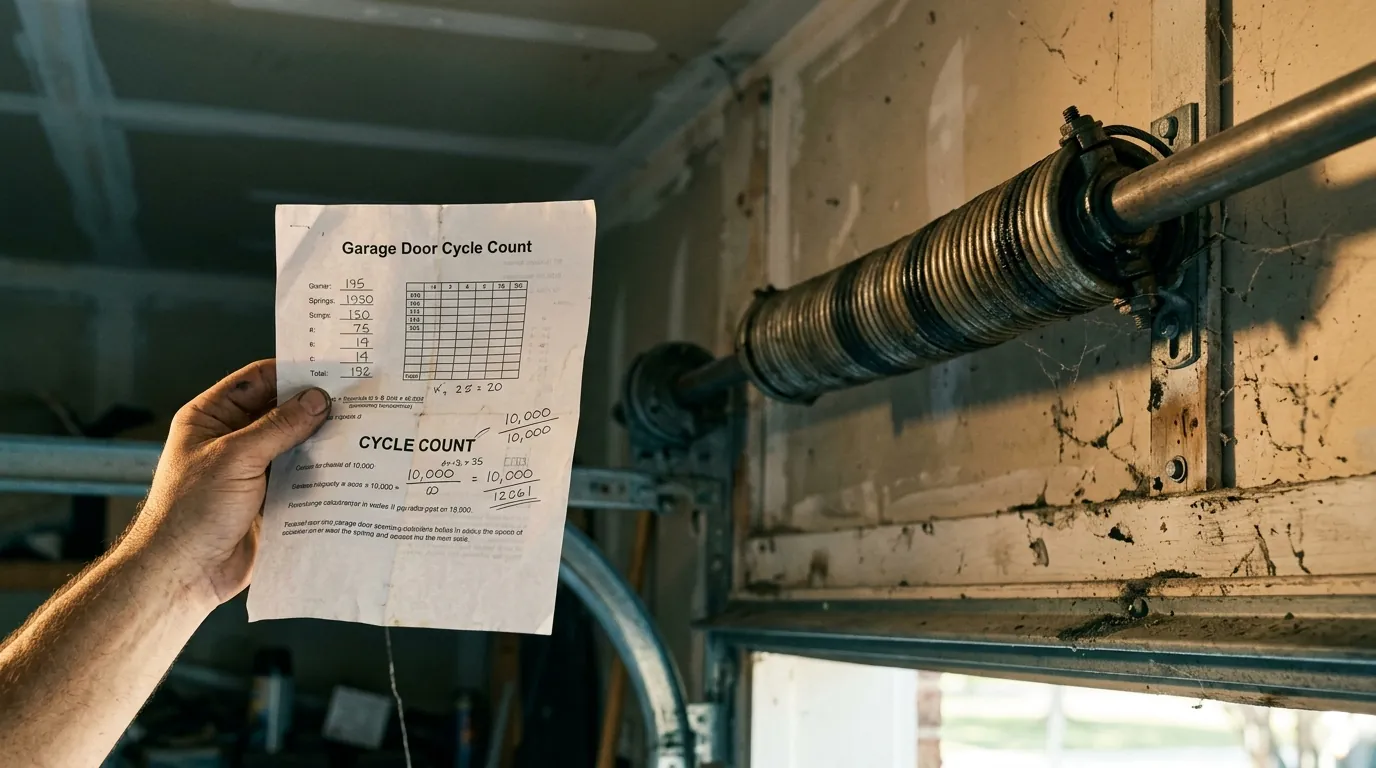
Springs older than seven or eight years? Call and we will check them before they break.
What shortens spring life in Houston
Rust is the main local factor. Relative humidity at Bush Intercontinental runs above 90 percent most mornings, and bare spring wire spends a lot of time damp. Rust pits the wire, and cracks start at the pits, so a rusty spring often breaks before its cycle rating.
Springs that are wound incorrectly, or sized wrong for the door's weight, also wear faster, and so do springs on a door that has had heavy panels or insulation added without the springs being re-sized.
Signs a spring is close to breaking
A door that feels heavier than it used to, drifts down when you stop it halfway, or makes the opener strain are all signs the springs are losing tension. Visible rust, a stretched-looking coil, or a gap in a torsion spring mean it is at or past the end. The torsion spring and extension spring pages describe the replacement.
Do not test a spring by adjusting it yourself. The tension can cause serious injury.
High-cycle springs and replacing in pairs
High-cycle springs cost more but last longer, which suits a door that is the main way in and out of the house. On a two-spring door, both springs are replaced together because they have done the same number of cycles. The spring cost guide covers typical prices, which This Old House puts at $120 to $350 for most doors in 2026.
Oiling the coils during a yearly tune-up slows rust and helps springs reach their rated cycles.
Questions readers ask
Garage door spring lifespan questions
They are rated in cycles. Standard springs are commonly rated around 10,000 cycles, which is often around seven years on a busy door.
One full open and close of the door.
Yes. They are rated for many more cycles than standard springs.
Heavy use, rust from humidity, or springs sized wrong for the door are the usual reasons.
Oiling the coils and keeping the door balanced helps. A yearly tune-up covers both.
Yes, on a two-spring door. The other spring has done the same number of cycles.